
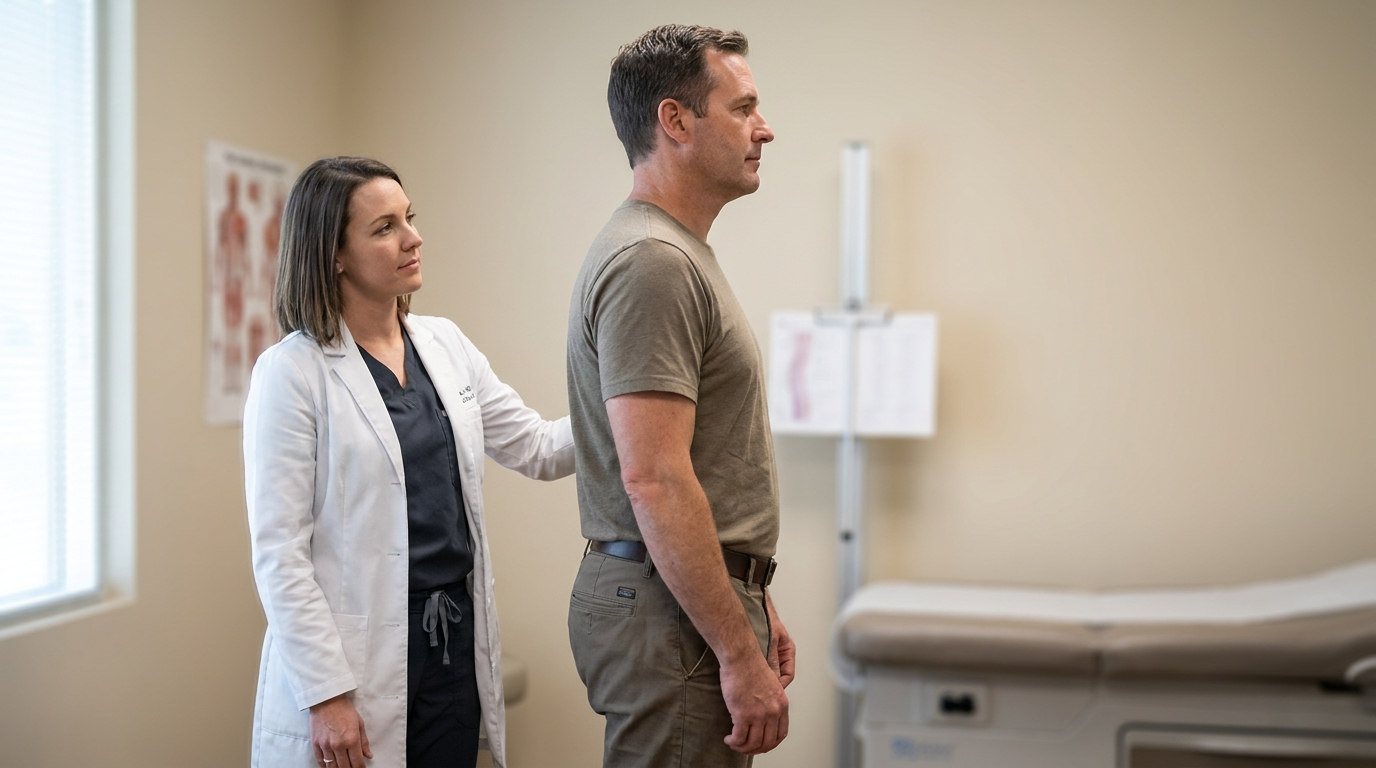
What a posture assessment is
A posture assessment is a structured evaluation of how you hold your body when you stand, sit, and move. Rather than treating a single sore spot, our providers look at the bigger picture: the alignment of your head, shoulders, spine, and hips, and the habits that may be loading certain muscles and joints unevenly. At Apex Health Acupuncture and Chiropractic, our licensed providers use this assessment to identify postural patterns that could be contributing to pain or stiffness, then build a correction plan around what they find.
The goal is not a single “perfect” posture frozen in place. It is helping you move and sit in ways that put less strain on your body across a normal day, whether you are at a desk, on your phone, or carrying a bag across the city.
How it works (and what the evidence says)
Posture matters because the body works best when its joints and muscles share load in a balanced way. Habitual positions, such as a forward head from screen time or a slumped lower back, can leave some muscles overworked and others weak. A posture assessment maps those patterns so we can target them with specific corrections, exercises, and ergonomic changes.
We will be candid about the evidence. Good posture supports the spine and can help prevent common aches, and clinical guidance emphasizes maintaining the natural curves of the spine, especially during recovery from low back pain. Research links poor posture with weaker spinal muscles, back pain, and lower quality of life, and studies show that active correction methods can reduce pain and improve posture. At the same time, posture is only one factor among many, and there is no single ideal posture that fits everyone. So we treat assessment and correction as a practical, supportive part of your care, not a standalone cure.
Conditions it can help
A posture assessment is most useful when alignment and daily habits are part of the problem. At Apex Health it commonly supports people dealing with:
It pairs naturally with our chiropractic care and massage therapy services, where correcting how you hold your body helps the results of other treatments last longer.
What to expect, step by step
A posture assessment is observational and collaborative, with no force involved.
- Conversation. We ask about your pain, your daily routine, your work setup, and any activities that tend to flare your symptoms.
- Standing and seated observation. Our provider looks at your alignment from the front, back, and side, noting head position, shoulder level, spinal curves, and hip balance.
- Movement checks. We watch how you bend, turn, and sit to see which patterns appear when you move, not just when you stand still.
- Findings. Our provider walks you through what they observed in plain language and explains how it may connect to how you feel.
- Correction plan. We give you targeted exercises, simple positioning cues, and ergonomic suggestions for your desk, phone, or sleep setup, and we set a path for follow-up.
Does it hurt, and are there side effects?
The assessment itself is comfortable and non-invasive. There are no adjustments or strong forces involved, just observation and gentle movement that you control. You will not feel pain from the evaluation.
The correction work that follows is gentle by design. As you change long-standing habits and begin new exercises, you may notice mild, temporary muscle soreness, much like starting any new movement routine. That usually settles within a day or two. If a particular exercise or position reproduces your pain, stop and tell us so we can adjust it. The whole point of correction is to reduce strain, not add it.
Who should avoid or postpone it
The assessment is safe for almost everyone, but the corrective exercises that follow may need adjustment or clearance in some situations. Tell us in advance if any of these apply:
- A recent fracture, acute injury, or recent surgery affecting the spine or limbs.
- Severe osteoporosis or fragile bones.
- Numbness, tingling, weakness, or any loss of bladder or bowel control, which needs medical evaluation first.
- Severe or escalating pain that has not been examined by a doctor.
- An active inflammatory flare or significant joint instability.
- Dizziness or balance problems that make certain positions unsafe.
If your symptoms point to something that needs medical attention before exercise, we will tell you and recommend the right next step. Our providers would rather refer you on or modify the plan than hand you exercises that are not safe for your situation. Honest guidance is part of the service.
Book an appointment in NYC
- Midtown — 280 Madison Ave, Suite 800 · (212) 242-3210
- Downtown — 217 Broadway, Ste. 512 · (347) 213-7035
- Chelsea — 37 West 20th St, Ste 1010 · (646) 935-9284
This page is for general information and is not a substitute for personalized medical advice, diagnosis, or treatment.
Frequently asked questions
Is there one correct posture I should hold all day?
No. There is no single ideal posture that fits everyone, and staying frozen in any one position is not the goal. We help you move and sit with less strain and shift positions through the day.
Will fixing my posture cure my back or neck pain?
Not on its own. Posture is one contributing factor among several. Correction can reduce strain and support your recovery, and it works best alongside other care that addresses the underlying issue.
Does the assessment involve any cracking or adjustments?
No. The assessment is observation and gentle movement only. If an adjustment is appropriate for you, that would be a separate chiropractic treatment we would discuss first.
How long does it take to see a change?
Posture habits take time to reshape. With consistent exercises and small daily adjustments, many people notice gradual improvement over weeks rather than days.
Will I get exercises to do at home?
Yes. A practical correction plan usually includes targeted exercises, positioning cues, and ergonomic tips for your desk, phone, and sleep setup so the gains carry into daily life.
Is the assessment uncomfortable?
No. It is comfortable and non-invasive, with no strong forces involved. You stay in control of every movement throughout.