
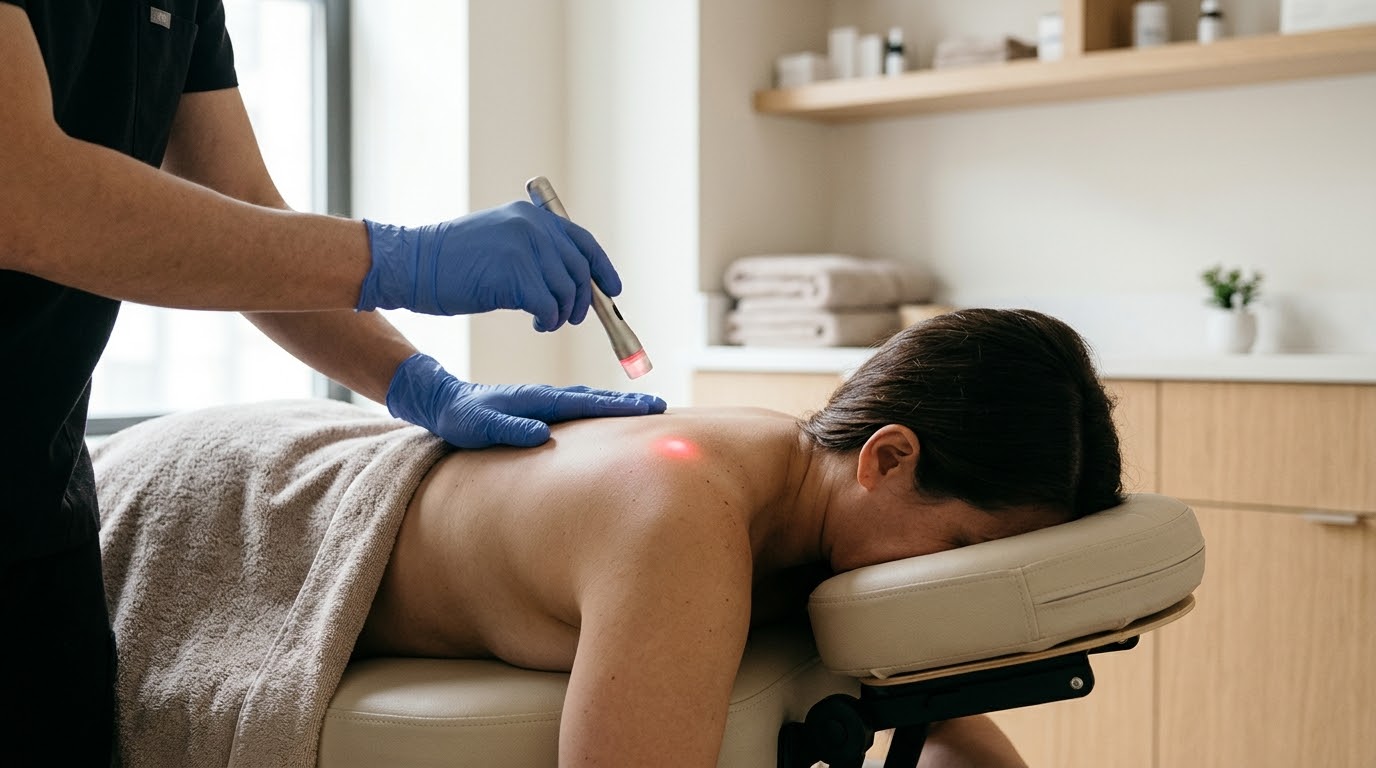
What cold laser therapy is
Cold laser therapy uses a low-level beam of light applied to the skin over a sore or injured area. It is also called low-level laser therapy or photobiomodulation. The word “cold” is the key detail: unlike the lasers used for surgery or hair removal, this light does not heat or damage tissue. You feel little or nothing during treatment, and the device rests gently against or just above the skin.
At Apex Health Acupuncture and Chiropractic, cold laser is used as a supportive tool within a wider plan. It is not a stand-alone fix. Providers often pair it with chiropractic care, hands-on soft-tissue work, and guided movement so that the light therapy supports the active part of your recovery rather than replacing it.
How it works
The idea behind cold laser therapy is that specific wavelengths of light are absorbed by cells and may influence the way those cells produce energy. Supporters believe this can encourage local circulation, calm inflammation, and support the body’s natural repair process. Because the light is low intensity, it does not raise the temperature of the tissue in a way that changes its structure.
Here is the honest picture of the evidence. Several reviews suggest cold laser can help reduce pain in some musculoskeletal conditions, and the technology has received clearance for the temporary relief of muscle and joint pain. However, the results across studies are mixed and inconsistent, and the effect on actual function, rather than pain alone, is less clear. Outcomes also seem to depend on using the correct dose and settings. We treat cold laser as a reasonable add-on with modest, variable evidence, not a miracle device.
Conditions it may help
Cold laser is most often considered for localized pain and soft-tissue irritation. Providers at Apex Health may use it as part of a plan for:
- Lower back pain and general back pain
- Neck pain and stiffness
- Plantar fasciitis and heel pain
- Rotator cuff injury and shoulder discomfort
Because the evidence varies by condition, your provider will be honest about whether cold laser is likely to add value in your specific case or whether another approach makes more sense.
What to expect, step by step
Cold laser sessions are simple, quick, and painless for most people:
1. Assessment. Your provider reviews your symptoms and confirms the precise area to treat.
2. Eye protection. You and the provider may wear protective eyewear as a standard precaution, since the device emits light.
3. Application. The handheld device is placed on or near the skin over the target area. It is moved slowly across the region or held over specific points.
4. During treatment. You may feel a gentle warmth or nothing at all. There is no needle, no pressure, and no discomfort in most cases.
5. Afterward. There is no downtime. You can usually return to your normal day immediately, and your provider may combine the session with other care.
Sessions tend to be brief, and a course of several visits is common since the effect is thought to build gradually.
Does it hurt, and what are the side effects
Cold laser therapy is one of the most comfortable treatments offered, because it is non-invasive and does not generate meaningful heat. Most people feel little to nothing during the session.
Side effects are uncommon and usually minor. A small number of people notice mild, temporary tenderness or a brief increase in symptoms before they settle. The most important practical precaution is eye safety, which is why protective eyewear may be used and why the beam is never pointed toward the eyes.
Who should avoid it or use caution
Cold laser is gentle, but it is not appropriate for every situation. Let your provider know if any of the following apply:
- You are pregnant, since treatment is generally avoided over the abdomen and lower back during pregnancy
- You have an active or suspected cancer, in which case laser is not applied over the area
- You have a fever or active infection in the region to be treated
- The area has an open wound, rash, or recently treated skin
- You take medication that increases light sensitivity
- The site is directly over the thyroid, an active growth plate in children, or a recently injected steroid site
If cold laser is not suitable, your provider can suggest alternatives such as massage therapy, electric stimulation, or other soft-tissue techniques. The point is to choose the safest, most useful option for you.
Book an appointment in NYC
- Midtown — 280 Madison Ave, Suite 800 · (212) 242-3210
- Downtown — 217 Broadway, Ste. 512 · (347) 213-7035
- Chelsea — 37 West 20th St, Ste 1010 · (646) 935-9284
This page is for general information and is not a substitute for personalized medical advice, diagnosis, or treatment.
Frequently asked questions
Does cold laser therapy hurt?
No. It is non-invasive and does not heat the tissue meaningfully. Most people feel a gentle warmth or nothing at all during the session.
How is cold laser different from a surgical laser?
Surgical and cosmetic lasers use high energy to cut or heat tissue. Cold laser uses low-level light that does not damage or heat tissue, which is why it feels comfortable.
Does cold laser therapy really work?
The evidence is mixed. Some studies show reduced pain in certain conditions, while results vary and the effect on function is less clear. We treat it as a modest, supportive add-on, not a cure.
How many sessions will I need?
A short course of several visits is common, since the effect is thought to build over time. Your provider will tailor the number to your response and your condition.
Is there any downtime?
No. You can typically resume your normal activities right after a session.
Are there side effects?
They are uncommon and minor, such as brief tenderness. The main precaution is eye safety, so protective eyewear may be used.
Can I combine cold laser with other treatments?
Yes. It is usually used alongside chiropractic care, soft-tissue work, or guided exercise, since it works best as part of a broader plan.
Resources
- Low-Level Laser Treatment for Lower Back Pain (NIH Bookshelf)
- Effects of Low-Level Laser Therapy on Pain in Musculoskeletal Disorders: Systematic Review and Meta-Analysis
- Effectiveness of Low-Level Laser Therapy for Nonspecific Chronic Low Back Pain
- Low-Level Laser Therapy as a Treatment for Chronic Pain